
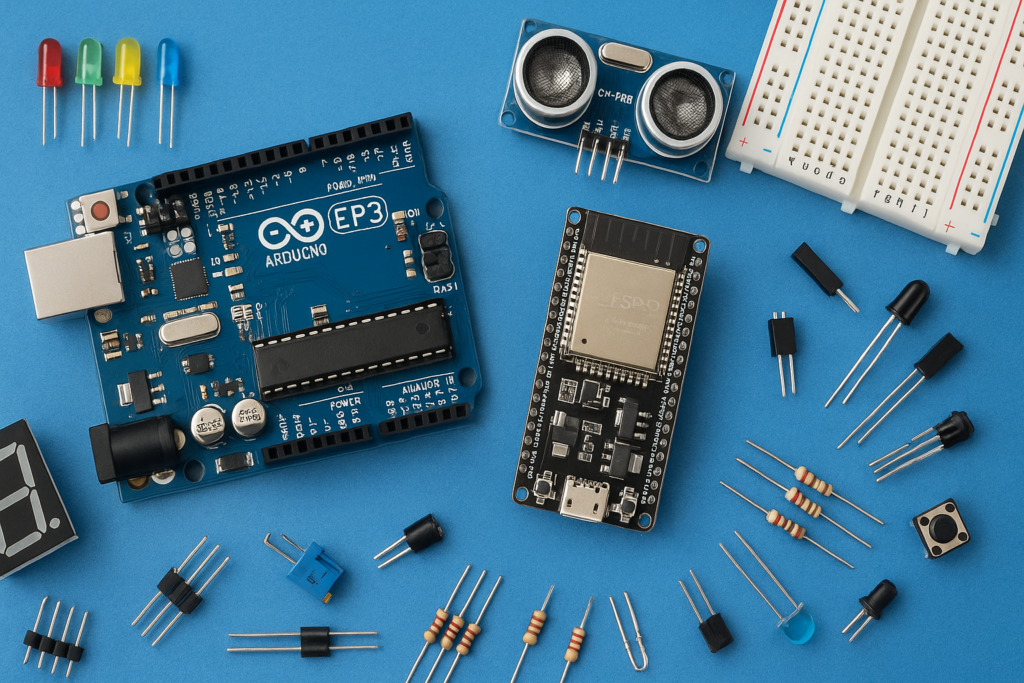
This project outlines how to build a classic LED Chaser Circuit, often called a moving light effect or sequencer. This visually engaging circuit relies on two key integrated circuits: the versatile 555 Timer and the CD4017 Decade Counter/Divider to sequentially light up a row of LEDs.
Key Components Required
- 555 Timer IC: Functions as the signal generator.
- CD4017 IC (Decade Counter): Functions as the sequential switch.
- LEDs (typically 10): The lights that create the chasing effect.
- Resistors: 1kohm and 460 ohms; Used for current limiting (for the LEDs) and setting the oscillation frequency.
- Capacitors: 1uf; Used to set the time delay of the 555 timer and for decoupling.
- Power Supply (Battery): 9V; A low-voltage DC source.
How it works:
An LED chaser circuit is a fun electronics project that creates moving light effects, where LEDs light up one after another in a sequence, making it look like lights are chasing each other.
This circuit uses two popular chips: the 555 timer and the CD4017 decade counter. The 555 timer acts like a clock, sending a series of pulses at a steady speed. These pulses are like beats that tell the CD4017 chip when to move to the next LED.
The CD4017 chip is a special counter that has 10 outputs. Each pulse from the 555 timer makes the CD4017 turn on the next output in line while turning off the previous one. This way, the LEDs connected to these outputs light up one by one, creating a chasing or running light effect.
You can control how fast the LEDs move by changing the timing components (resistor and capacitor) connected to the 555 timer. This is an exciting way to learn about timers, counters, and how to control LEDs in electronics.
This LED chaser is used in decoration lights, signage, and fun projects to grab attention with moving lights.
Watch the full video tutorial here: How to make an LED chaser circuit using 555 & 4017 || moving LED lights