
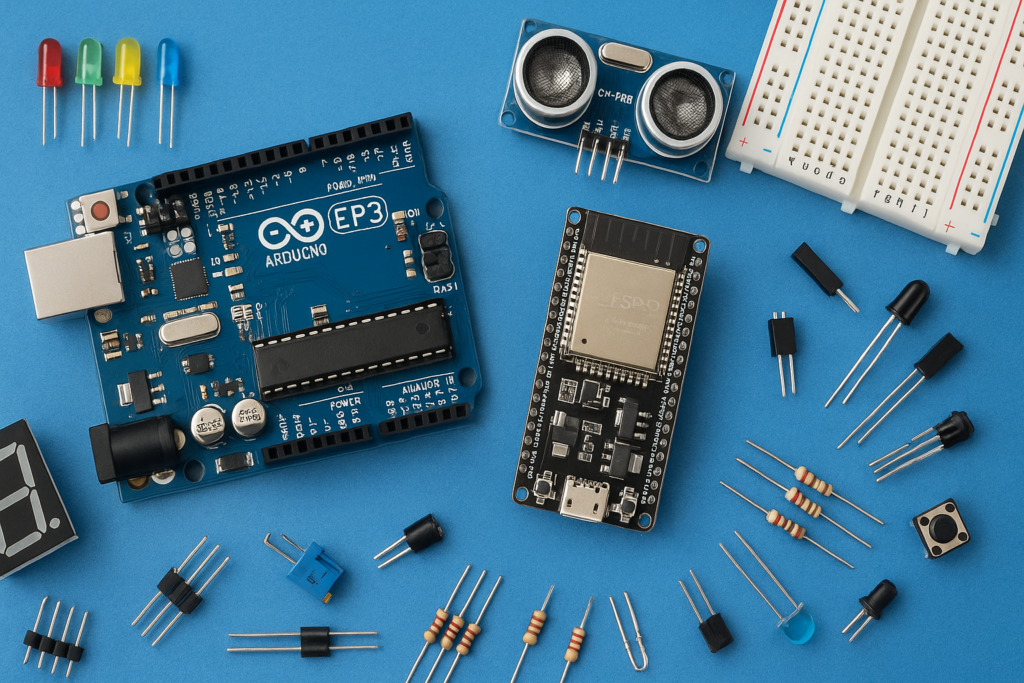
This project helps to automatically turn ON a light or LED when it gets dark and turn it OFF when it’s bright, just like automatic street lights.
Key Components Required
- BC 547-1
- LED (any colour)-1
- LDR-1
- Resistors- 330Ω & 47 KΩ
- Battery-9v

How It Works
- The core sensor is the LDR (Light Dependent Resistor), which acts like an eye that changes its resistance based on the light falling on it.
- In bright light, the LDR’s resistance is low, so it allows more current to flow. This lowers the voltage at the base of the BC547 transistor.
- When the base voltage is below a certain level, the BC547 transistor stays OFF, so the LED or light stays OFF.
- When it becomes dark, the LDR’s resistance increases, reducing current flow. This raises the voltage at the transistor’s base.
- Once the base voltage crosses the transistor’s threshold (around 0.7V), the BC547 transistor switches ON, allowing current to flow through the LED, turning it ON.
- As a result, the LED glows when it’s dark and turns OFF when light is present.
Applications
This principle is the basis for many automated systems:
- Street Lights: Automatically turning streetlights on at dusk and off at dawn.
- Photography: Controlling the shutter speed on older cameras.
- Security: Creating basic perimeter alarms or light activation systems.
Watch the full video tutorial here: How to make a light sensor at home|Darkness detector using LDR and transistor BC547 with explanation